
Mumbai Can’t Stop Playing Pickleball — But Your Feet Didn’t Sign Up For It
By Dr. Pallavi Singh · Stride Podiatry
There is a new sound on the rooftops of Bandra and the clubs of South Mumbai: the hollow pop of a paddle meeting a perforated plastic ball. Pickleball — and its stylish cousin, padel — has become the city’s favourite way to socialise, sweat and show up on everyone’s Instagram stories. Courts are booked solid from Juhu to Colaba, and if you have played even once, you already know the problem: it is gloriously, completely addictive.
Last month you played zero times. This week you have played four. The paddle feels light in your hand, the games fly by — and somewhere underneath all that fun, a part of your body is quietly doing the heavy lifting and getting no credit for it. Your feet. They never signed up for this, and they will be the first to let you know.
Why pickleball is harder on your feet than it looks
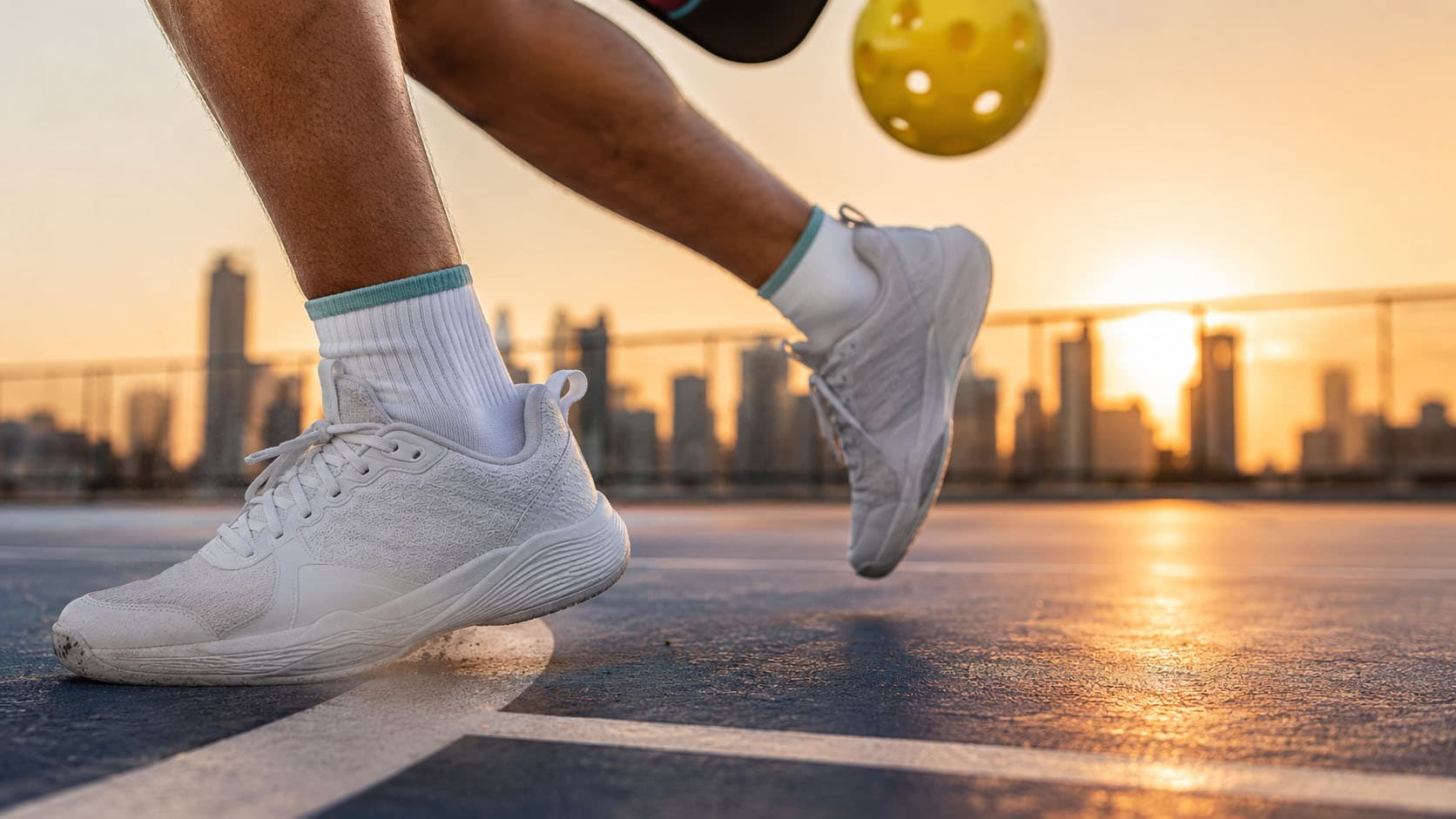
Pickleball looks gentle. It is played on a small court, the rallies are social, and nobody seems to be sprinting. But watch your own feet for a single point and you will see the truth. You shuffle, you stop dead, you cut sideways, you lunge for the kitchen line, you pivot on the ball of your foot and push off again — all in a few seconds, over and over.
This is the key difference. A jog is forward, rhythmic and predictable; your feet know what is coming. Pickleball is multidirectional and unpredictable, and every sudden change of direction is absorbed, braked and redirected by your feet and ankles. On a hard court, that is a serious amount of work for a part of the body most of us never train.
The “too much, too soon” trap
Here is the pattern we see again and again. The sport is so enjoyable and so social that players go from nothing to several sessions a week almost overnight. The foot is a remarkably capable structure — it can handle several times your body weight with every step — but only the load it has been prepared for.
Add load too fast, too soon, and the tissue simply says you were not ready. That is the story behind a great many cases of plantar fasciitis — the sharp heel pain that is worst with your first steps in the morning. It rarely arrives because of one bad moment; it builds because the playing volume climbed faster than the foot could adapt.
A 24-year-old from Bandra came in after six weeks of near-daily pickleball. He had no injury moment to point to — just a heel cord that had gone from slightly tight to genuinely painful. His feet had simply not been given time to catch up with his new favourite sport.
The foot and ankle injuries pickleball players actually get
A few injuries turn up far more often than the rest among paddle-sport players:
- —Ankle sprains.The quick lateral cuts are exactly how ankles roll. Worse, a mild sprain that is “shaken off” and never properly rehabbed leaves the ankle unstable and likely to roll again — a common foot injury that quietly lingers for years.
- —Achilles tendon pain. That explosive push-off towards the net loads your heel cord with several times your body weight. Pushed too hard, too often, it becomes Achilles tendonitis — and the Achilles is famously slow to forgive.
- —Heel pain. Hard courts and a sudden jump in volume are a classic recipe for plantar fasciitis and, over time, heel spurs.
- —Forefoot pain. Every pivot and push-off drives huge force through the ball of your foot. A persistent ache there — metatarsalgia — is your forefoot asking for help.
Behind several of these sits one quiet factor: how your foot is built and how it moves. If your foot rolls inwards more than it should — a pattern called overpronation — every one of these stresses is amplified.
You are probably playing in the wrong shoes
Now the part that will sting a little. Most people pick up pickleball in whatever is already on their feet — running shoes, or the lifestyle sneakers that look good courtside. Both are the wrong tool.
Running shoes are designed for one thing: forward motion, in a straight line, with plenty of cushion. Pickleball asks for the opposite — side-to-side stability and a real connection to the court. A tall, soft, cushioned sole actually makes it easier to roll an ankle, because your foot sits further from the ground and feels less of what it is doing. The shoe that looks sharp in your court selfie may be the very thing setting you up for an injury. A proper court shoe, with lateral support and a lower, firmer sole, is not a detail — it is protection.
How to keep playing — without paying for it later
The goal is never to talk you out of a sport you love. It is to keep you on the court. A few habits do most of the work: build your playing volume up gradually rather than all at once; warm the ankles, calves and feet before you start, not just the arms; and treat early niggles as information, not something to push through. A “chalta hai” shrug at a sore heel today often becomes weeks off the court later.
It is also worth getting genuinely stronger from the ground up. Stronger feet, calves and ankles give you a stable platform for all that cutting and pivoting — and they are trainable at any age. You cannot build a powerful game on a weak foundation.
When a niggle will not settle, get it checked
If foot or ankle pain has hung around for more than a couple of weeks, or keeps returning every time you play, that is the signal to look closer. At Stride Podiatry, a biomechanical analysis and gait analysis show exactly how your feet load, move and absorb force, so the cause is identified rather than guessed at. From there, manual therapy and a targeted strengthening plan get you back to the kitchen line — and keep you there. The goal is simple: treat the root cause, not just the symptom.
Quick Questions
From players
Yes. Court shoes are built for the side-to-side movement the sport demands. Running shoes and lifestyle sneakers are made for forward motion and can leave your ankles exposed.
Not necessarily. Complete rest often feels better briefly, then the pain returns the moment you play again. A short assessment will tell you whether to modify, strengthen or treat — which beats guessing.
Absolutely. These injuries are driven by sudden jumps in load and by footwear, not by age. Young, fit players who ramp up quickly are squarely in the at-risk group.
Related conditions we treat
Keep playing the game
you have fallen for.
Book a sports foot assessment at Stride Podiatry — our Vile Parle East clinic is an easy reach from Juhu, Bandra and South Mumbai. We will find the cause and get you back to the kitchen line.