
School Shoes, Monsoon Socks and Growing Feet: What Every Mumbai Parent Should Know
By Dr. Pallavi Singh · Stride Podiatry
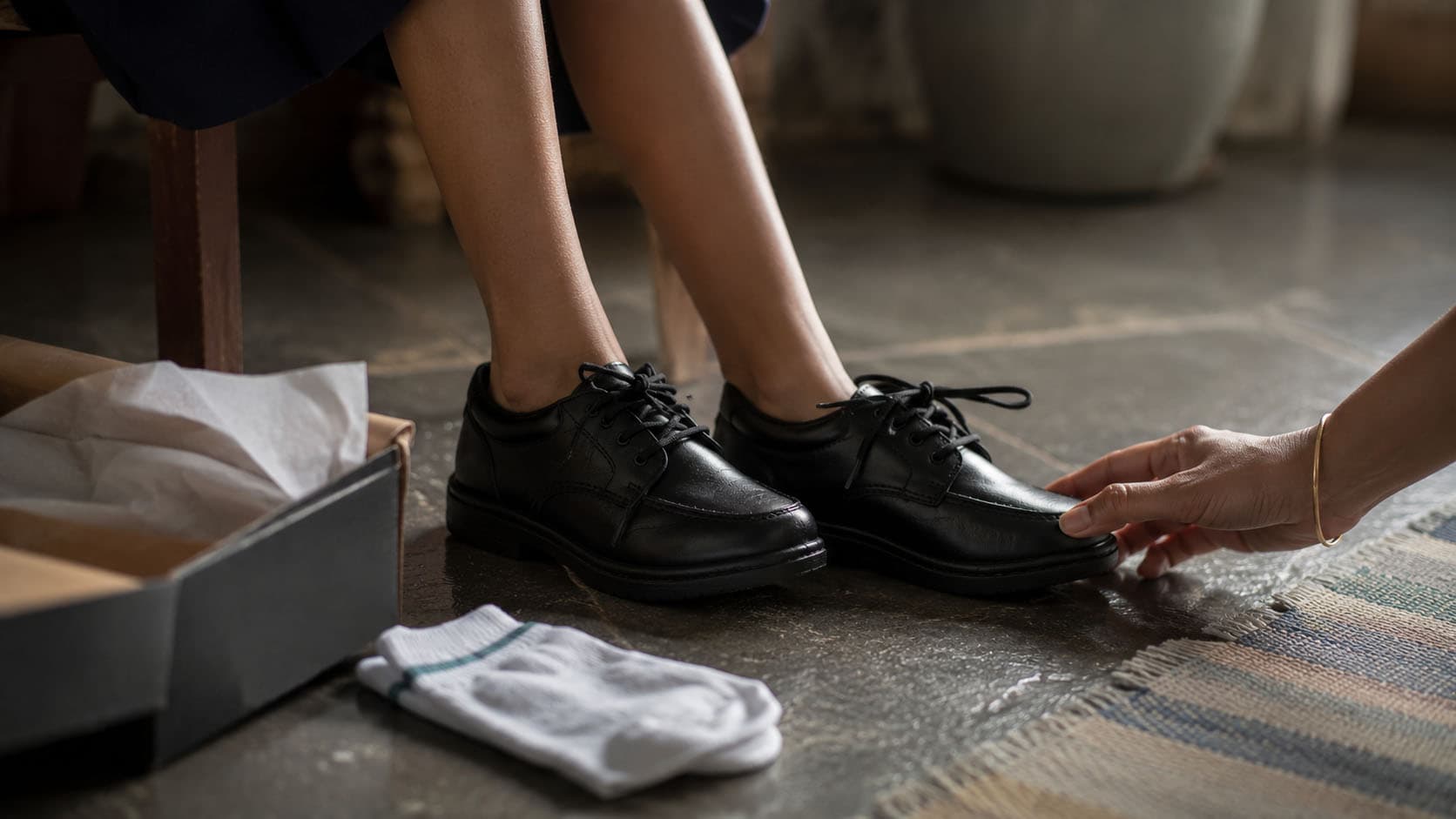
It is a familiar June ritual. The school year is about to begin, so you take your child to a shop in Bandra or a mall off Juhu, find this year’s school shoes, press a thumb against the toe to check the size, and you are done in five minutes. Somewhere in the same week, the first heavy clouds roll in over the Arabian Sea, and the monsoon arrives.
Two ordinary seasonal rituals — new shoes and wet weather — and both land squarely on the part of your child’s body that is quietly still being built, and most easily overlooked: their feet. The good news is that this same season is a real opportunity. A few small, well-informed choices over the next few weeks can shape how your child walks, runs and plays for decades.
Your child’s foot is still a work in progress
A child is not born with finished feet. The arch you can see in an adult develops through the early childhood years, and key bones in the foot only harden into their adult shape around the age of seven. Beneath the skin sit four layers of muscle that are designed to move, grip and feel the ground. In other words, your child’s foot is being trained every single day — and whatever it spends its hours inside is quietly part of that training.
This is why specialists say the same thing again and again: get footwear right in childhood, and a great many adult foot problems simply never begin. The window is open now. It will not stay open forever.
The school-shoe trap most parents fall into
Here is the uncomfortable part. School shoes are closed, often stiff, and worn for six to eight hours a day, five days a week. And studies have repeatedly found that most children are walking around in shoes that are too narrow for them. The classic school shoe tapers to a point, while a real foot is at its widest across the toes. Every day, that mismatch gently squeezes a set of toes that are still deciding what shape to be.
Squeezed toes do not bounce back on their own. The crowded, overlapping toes you may have noticed on an adult — the beginnings of bunions and hammer toes — usually trace back to years inside shoes that never gave the toes room. Research comparing children has even found more flat-foot development among those in closed, restrictive shoes than among children who spent more time barefoot. The foot, it turns out, learns from what it is allowed to do.
A Khar couple brought in their nine-year-old, worried he had become “lazy” about football. He had not — his school shoes were a full size too tight, and his toes had nowhere to go. New shoes, a simple check, and he was soon back on the pitch.
How to choose a school shoe that actually fits
The reassuring news is that a good school shoe is easy to spot once you know what to look for. Three checks are enough.
- 1A genuine wide toe box. Note the difference between a “wide shoe” and a wide toe box — the room must reach all the way to the toes, not just the middle of the foot. The widest point of the shoe should sit under the toes.
- 2The insert test. Pull the insole out of the shoe, have your child stand on it, and look. If the toes or the side of the foot spill over the edge, the shoe is too narrow — whatever the label says.
- 3A flexible, level sole. The shoe should bend easily and sit your child’s heel and toes on roughly the same plane. Avoid stiff, board-like soles and built-up heels.
Shop in the evening, when feet are at their largest, and leave a little growing room — about a thumb’s width — without the shoe being sloppy. A shoe that fits well is one your child forgets they are even wearing.
Monsoon — when wet feet become a real problem
Then come the rains. A child who steps in one puddle on the way to the school bus can spend the whole day in damp socks and shoes, and that is where monsoon foot trouble begins. Trapped moisture softens the skin, invites fungal infections such as athlete’s foot, and rubs up blisters. Wet, tight shoes also press toenails into the skin — a common route to painful ingrown toenails. And slick footpaths and staircases mean more slips, and more twisted ankles and foot injuries.
A few simple habits carry a child through the season well. Pack a spare pair of dry socks in the school bag. Keep two pairs of school shoes and let each dry fully — a soaked shoe needs a day, not a night. Trim toenails straight across, not curved into the corners. And dry carefully between the toes after every bath. None of it is complicated; all of it adds up.
The signs that say “get those feet checked”
Children rarely announce a foot problem clearly. They are far more likely to simply slow down, ask to be carried, or quietly opt out of a game. It is worth paying closer attention if your child:
- —often complains of tired or aching feet, legs or knees, especially after sport;
- —trips frequently, scuffs their toes, or seems unusually clumsy;
- —wears down one shoe far faster, or differently, from the other;
- —has toes that look crowded, a bump starting to form, or feet that turn noticeably in or out.
Flat feet, on their own, are usually normal in young children and nothing to fear. Flat feet that are stiff, painful, or clearly making your child avoid activity are worth a closer look — as is the rolling-in pattern called overpronation. At Stride Podiatry, a biomechanical analysis, gait analysis and foot pressure mapping show exactly how your child’s feet are loading and moving, so any advice rests on evidence rather than guesswork. Often the answer is simply better footwear and a little time; where genuine support is needed, customised orthotics can help. The aim is always the same — treat the root cause, not just the symptom.
A small step now, a longer stride later
One last, easy thing: let your child be barefoot whenever it is safe to be. Time on grass, on the sand at Juhu beach, on natural ground lets young feet feel, grip and grow strong in the way they were designed to. It is the simplest foot exercise there is — and children love it.
The school shoe you choose this fortnight and the monsoon habits you set now are small decisions. But they land at exactly the moment your child’s feet are being built, which makes them some of the most valuable decisions you will make this year. If anything about your child’s feet has been quietly nagging at you, have them looked at.
Quick Questions
From parents
Usually not. Most young children have flat-looking feet, and the arch develops naturally over time. It is worth a check only if the flatness is stiff or painful, or if your child avoids activity because of it.
Young children's feet can grow surprisingly fast — often every few months. Check the fit each term rather than once a year, and replace shoes as soon as the toes reach the end or the shoe loses its shape.
Not necessarily. Price and popularity do not guarantee a good fit. A wide toe box, a flexible sole and the correct length matter far more than the logo.
Related conditions we treat
Give your child’s feet
the best possible start.
Book a children’s foot check at Stride Podiatry — our Vile Parle East clinic is a short drive from Juhu, Khar and Bandra. We will check, explain and guide you, with no jargon and no guesswork.